
Co-regulation before correction
11 min read
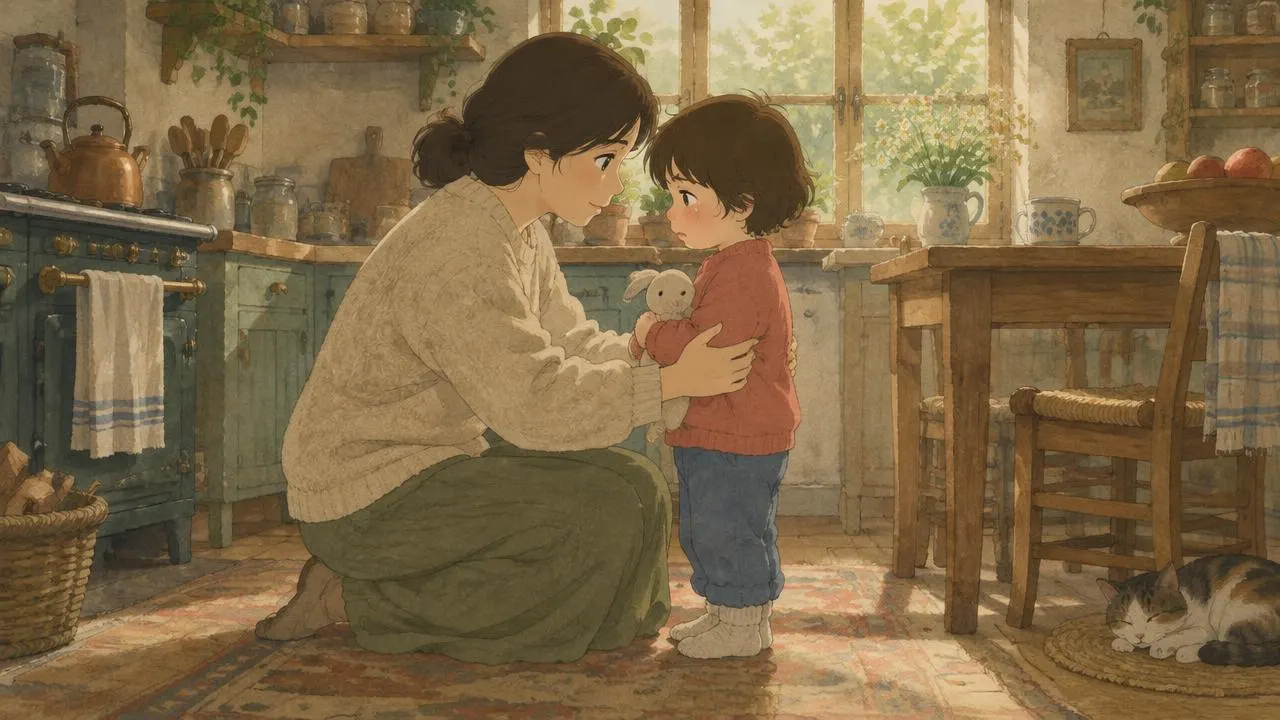
When a child is in the middle of a big feeling, most of us reach for the words we were given as children: "Calm down." "That's enough." "Go to your room until you can behave." These words usually come from a loving place. We want the shouting to stop, we want our child to be safe, and we want them to learn that some behaviour is not okay. But there is a quieter, gentler step that tends to work better, and it comes first: co-regulation.
This article explains what co-regulation is, why it matters for children aged roughly 8 to 16, and how you can practise it in ordinary family life. It is not a set of rules, and it is not about being a perfect parent. It is about noticing what your child's nervous system needs in a hard moment, so that the learning you want for them has a chance to land.
What co-regulation actually means
Co-regulation is the process by which one person's calmer nervous system helps another person's nervous system settle. Babies depend on it completely: they cannot soothe themselves, so they borrow calm from the adults who rock, hold and talk to them. Developmental researchers, including those at the Center on the Developing Child at Harvard University, describe this "serve and return" relationship as one of the foundations of healthy emotional development.
What is less well known is that the need for co-regulation does not disappear when a child starts school. The parts of the brain involved in planning, reasoning and managing impulses keep developing right through childhood and adolescence, and into the mid-twenties. A nine-year-old, or a fourteen-year-old, may sound very grown up when they are calm. When they are flooded with feeling, though, those reasoning skills can go temporarily offline. In those moments they still need to borrow some of our steadiness.
Self-regulation, the ability to manage our own feelings, is not something children simply decide to do. It grows slowly, out of many, many experiences of being regulated alongside someone else. In other words, children learn to calm themselves by first being calmed with us.
Why correction often doesn't work in the moment
Imagine you are furious, or frightened, or deeply embarrassed. Now imagine someone tells you, in a firm voice, exactly what you did wrong and what the consequence will be. Most adults would find it hard to take that in. We might argue, shut down, or say things we later regret.
Children are the same, only more so. When a child is highly distressed, their body is often in a stress response: heart racing, breathing quick, muscles tense. Psychiatrist Dan Siegel uses the phrase "window of tolerance" to describe the zone in which we can think, listen and learn. Above that window, we become overwhelmed and reactive. Below it, we can become numb, withdrawn or frozen. Correction offered when a child is outside their window is unlikely to be heard, however wise it is.
That is not the same as saying boundaries don't matter. They matter a great deal. It simply means the order is important. Connection and calm first, then conversation and learning. Many parents find the phrase "connect before you correct" a helpful reminder.
What it can look like in real life
Co-regulation is less about what you say and more about how you are. Your child's nervous system reads your face, your tone of voice, your posture and your breathing long before it processes your words. Here are some things that often help.
- Lower your voice rather than raising it. A slower, softer voice signals safety.
- Get physically lower, sitting or kneeling nearby, so you are not towering over them.
- Slow your own breathing. You do not need to announce it; children often start to match you.
- Use fewer words. Long explanations can feel overwhelming when someone is flooded.
- Offer presence without pressure: "I'm right here. You don't have to talk."
- Name what you see, gently and without judgement: "That was really disappointing."
- Keep everyone safe. If something is dangerous, calmly move it or step in, without adding a lecture.
For some children, touch is comforting: a hand on the back, a hug when they are ready. For others, especially children who experience sensory sensitivity, touch in a heated moment can feel like too much. It is always fine to ask, "Would a hug help, or would you like some space with me nearby?" Respecting their answer is itself part of teaching boundaries.
A short example
Nine-year-old Ellie has spent an hour on a drawing. Her little brother knocks water over it. She screams, tears the paper, and shouts that she hates him.
A correction-first response might be: "Ellie, we do not say hate. Go and apologise to your brother right now." Understandable, and the message about kindness matters. But Ellie is flooded. She is likely to shout louder, or storm off feeling that nobody cares about her ruined drawing.
A co-regulation-first response might sound like this. You kneel beside her, speak slowly, and say, "Oh, Ellie. Your drawing. You worked so hard on that." You might breathe out slowly, stay near, and wait. When her body starts to soften, maybe a few minutes later, you can gently say, "It's okay to be really cross. It's not okay to say hurtful things to your brother. When you're ready, let's think about what might help."
The boundary is still there. It has simply arrived when she is able to hear it.
What about older children and teenagers?
For teenagers, co-regulation often looks quieter and less direct. Many young people aged 12 to 16 find face-to-face intensity hard when they are upset. Side-by-side moments, such as a car journey, walking the dog, or cooking together, can feel safer. A teenager may not want you to name their feelings out loud, and that is okay. Sometimes co-regulation is simply staying calm when they are not, and not taking their sharpness personally in the moment.
It can help to say something like, "I can see today has been a lot. I'm not going anywhere. We can talk later if you want to." This leaves the door open without pushing. Many teenagers come back to a conversation hours later, often at bedtime, once they feel steadier.
Your own nervous system matters too
Here is the honest part: co-regulation asks us to be calmer than we might feel. That is genuinely hard, especially when you are tired, stressed, or when your child's behaviour touches something painful from your own childhood. No parent manages it every time.
A few things can make it more possible:
- Notice your own early signs of stress, such as a tight jaw, a hot face, or a raised voice.
- Give yourself permission to pause: "I need a minute to calm my body, then I'll come back."
- Take one slow breath out, longer than the breath in, before you respond.
- Remember that you do not have to fix the feeling. Your job is to be with it.
If you do lose your temper, which every parent does, repair is what matters most. Coming back later and saying, "I shouted earlier, and I'm sorry. You didn't deserve that. I was feeling overwhelmed," teaches your child something powerful: that relationships can survive difficult moments, and that grown-ups take responsibility too. Research on "rupture and repair", including work by developmental psychologist Ed Tronick, suggests that it is not the absence of mistakes but the reliable repair afterwards that helps children feel secure.
When the calm has returned: the learning part
Once everyone is settled, that is the moment for the conversation you wanted to have. This is sometimes called "emotion coaching", an approach described by psychologist John Gottman and widely used in UK schools. It usually includes:
- Noticing and naming the feeling: "You were really angry when your drawing got ruined."
- Showing that the feeling makes sense: "Anyone would feel upset about that."
- Being clear about behaviour: "Tearing things or saying hurtful words isn't okay, even when we're angry."
- Problem-solving together: "What could you do next time you feel that hot, cross feeling?"
Children are often much more willing to think about their behaviour when they feel understood. Feeling understood does not mean they "got away with it". It means their brain is now ready to learn.
Common worries parents share
"Isn't this rewarding bad behaviour?" This is a very common and reasonable concern. Co-regulation is not about giving in to demands, removing all boundaries, or pretending hurtful behaviour is fine. It is about responding to distress with calm, and then holding the boundary when the child can take it in. Many parents find that, over time, meltdowns become shorter and less frequent, because the child feels safer.
"What if my child needs to learn consequences?" Natural, proportionate consequences still have a place. The difference is that they are explained calmly, after the storm, rather than delivered in the heat of it. A consequence that makes sense to a child, like helping to clean up a mess they made, tends to teach more than one that feels like punishment.
"I don't have time for this every time." That is completely understandable. Real family life is busy and messy. Even small moments of co-regulation, a softer voice, a pause, a single kind sentence, count. You do not need to get it right every time for it to make a difference.
How our stories support this
In MySafeTherapy Kids, many stories include a short body check-in, where a character notices what is happening in their body before they decide what to do next. Pip the robin offers a gentle breathing pause. These moments are designed to help children practise noticing feelings in a calm, low-pressure way, so they have a little more to draw on in real life. They are not a replacement for your care, and the app does not diagnose or treat anything. They can, though, be a lovely starting point for a conversation: "What did Maya notice in her body? Do you ever feel like that?"
When to seek more support
Big feelings are a normal part of growing up. However, it may be worth talking to someone if your child's distress is very frequent or intense, if it is getting in the way of school, friendships or sleep, or if you notice changes that worry you, such as withdrawing, talking about hurting themselves, or seeming very low for a long time.
In the UK, your GP is a good first step. Your child's school may also have a pastoral lead, special educational needs coordinator (SENCo) or mental health support team. The YoungMinds Parents Helpline (0808 802 5544) offers free advice to parents in England, Scotland, Wales and Northern Ireland. Children and young people can talk to Childline confidentially on 0800 1111. If anyone is in immediate danger, call 999.
A simple phrase to keep in your pocket
In the heat of a difficult moment, it can be hard to remember any of this. Some parents find it helps to have one short phrase ready, for themselves as much as for their child. It might be "Calm first, words later", or simply, "I'm here, you're safe." Saying it quietly to yourself can create just enough pause to respond rather than react.
A gentle closing thought
Co-regulation is not a technique you master once. It is a way of being alongside your child that you will practise imperfectly, for years, and that is exactly as it should be. Every time you bring a little calm into a stormy moment, your child learns something about what safety feels like. Over time, that borrowed calm slowly becomes their own.
You are allowed to find this hard. You are allowed to get it wrong and try again. The fact that you are reading this suggests you already care deeply about getting it right for your child, and that care is the most important ingredient of all.
This article is general information, not medical advice. If you're worried about your child or yourself, speak to your GP, or call NHS 111. In an emergency call 999.